

Equine
Worm control in horses
Smarter, targeted worming with egg counts, to protect your horse and slow resistance in Orkney.
Every year our vets treat horses with worm-related problems. Most are caused by cyathostomes (small redworm) and pinworm, with some cases of colic suspected to be due to tapeworm.
The worms that matter
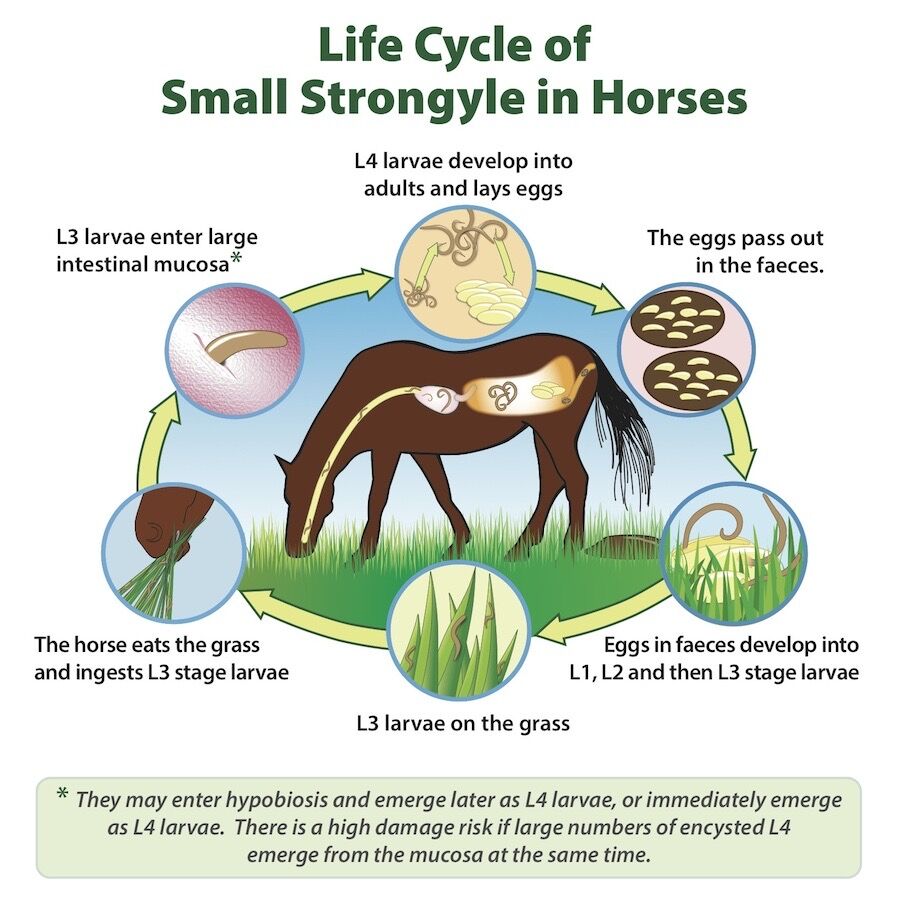
Cyathostomes (small redworm). Larvae migrating through the gut can severely damage the large colon, causing weight loss often with diarrhoea. This is known as larval cyathostomiasis. Irreversible damage can lead to permanent ill-thrift, and only 50% of badly affected horses make a full recovery. Horses of all ages can be affected, but it is most common under six years of age.
Tapeworm. Tapeworms attach in clumps where the caecum joins the colon. The inflammation that follows can seriously affect gut motility, and the main sign of a significant burden is colic, which can be more or less severe. Tapeworms do not cause weight loss.
Pinworm (Oxyuris). Fairly harmless in itself; the main problem is itchiness around the horse's back end, and some individuals are very sensitive. See Pinworm problems.
Pasture management comes first
For any worming programme to work long-term, good field management is essential: regular poo-picking can never be replaced by wormers.
- Collect droppings at least twice weekly to stop larvae spreading onto pasture.
- Alternate grazing with cattle and sheep: larvae aren't infectious to other species, so they are "vacuumed up".
- Close stocking of horses and ponies increases the risk of problems.
- Chain harrowing instead of poo-picking just spreads worms more widely.
- Worm horses new to the yard, with uncertain worming history, with Equest Pramox (moxidectin and praziquantel), then keep them off pasture for 3 days.
Traditional worming programme
This uses wormers all year round, whether or not the horse has a burden needing treatment. We strongly recommend the intelligent programme instead: worms are building resistance to the drugs we have, and there are no new drugs coming. We know we have resistant worms in Orkney and strongly advise against Panacur for routine worming; reserve it for foals, sick horses and special cases.
- Only moxidectin (Equest) and a 5-day course of fenbendazole (Panacur, if no resistance) are effective against encysted small redworm.
- Only wormers containing praziquantel, or double dose pyrantel (Strongid-P), are effective against tapeworm.
- Equest Pramox contains both moxidectin and praziquantel, a very powerful combination.
November
Equest Pramox
February
Ivermectin or pyrantel
May
Equest, ivermectin or pyrantel
August
Ivermectin or pyrantel
Intelligent worming programme
To slow resistance, this programme reduces wormer use by regularly monitoring egg counts in every horse sharing a pasture. A small number of worms is allowed to remain (refugia), as in the long run they produce offspring with no resistance to our wormers.
- Mar / AprWorm egg count (WEC). Positive (over 200 eggs per gram): worm, with the wormer your vet advises. Negative: no action needed.
- JuneWorm egg count. Positive: use wormer as advised. Negative: no action needed.
- Aug / SeptWorm egg count. Positive: use wormer as advised. Negative: no action needed.
- Oct / NovTapeworm test on blood or saliva, and use a tapewormer only if present. An Equest or Equest Pramox dose is obligatory in October or November to deal with any inhibited larvae in the gut.
Advantages of intelligent worming:
- Fewer wormers are used, which should delay resistance and keep existing wormers effective.
- Set-up costs are higher than the traditional system, but there should eventually be a saving on wormers.
- It's a "green" system, with fewer drugs given to horses.
- Monitoring faecal egg counts gives assurance that your worm control strategy is working.
Where several horses share a pasture, we advise individual egg counts for each horse: some are much more prone to worm burdens than others, and youngsters more than adults. Often about 20% of horses contribute up to 80% of the worm burden on a pasture. Only horses with a WEC of 200 epg or higher should be wormed. If WEC results aren't coming down, an extra count 2 weeks after worming may be advised in case of underdosing or resistance.
Worming foals
Foals are particularly sensitive to worms and pick up eggs from the environment and the mare's milk from birth. Under high infection pressure this can mean infection from 2 weeks of age, though in most foals no significant burden is present until 3 months. The most important worms in foals are threadworm (Strongyloides westeri) and large roundworm (Parascaris equorum), which can cause diarrhoea, slower growth, weight loss, a rough coat, colic and respiratory disease.
- Before 3 months: only worm if infection pressure is high (history of problems on the yard) or the foal has possible worm-related problems (diarrhoea, coughing, poor doer).
- At 3 months: pyrantel (Strongid-P).
- At 4½ months: ivermectin (Noromectin).
- At 6 months: join the mature horses on the yard with worm egg counts.
- We advise against Equest Pramox in foals under 8 months and Equest in foals under 6 months.
Pregnant and lactating mares: worm according to the normal schedule. If infection pressure is high (history of problems, many horses on the fields, no regular poo-picking), worm with Equest 2 weeks after foaling.
Horse worm program
£40inc VAT, per horse or pony
- Three worm egg counts: we remind you when to bring samples in
- 10% off wormers
- With three horses on the program, a fourth joins free
- A measuring tape for body weight estimation for worming
The worming program is also included in our equine health plan.
Taking samples for a worm egg count
Take large pinches from at least 3 balls of fresh faeces from each horse and place them in an individual plastic bag; the total from each horse should be about the size of a golf ball. Label the bag with your name, the horse's name and the date, and keep it in the fridge if collecting the night before. Please complete the form below when sending in samples.
Equine faecal worm egg count formPDF. Please complete and send in with your samples.